Is there a rent cap in England? The short answer
No. England has no rent cap, no rent control and no maximum percentage increase. The Renters' Rights Act 2025 — whose rent rules have applied since 1 May 2026 — considered a cap and rejected it. Landlords can charge, and propose, whatever they think the market will bear.
What the law does instead is limit the process and set a ceiling: rent can go up once a year, with two months' notice, on a prescribed form, and if you challenge it the First-tier Tribunal will hold the rent at the local open market level. It cannot go above that. For most tenants that ceiling matters more than a percentage cap would — it is what stops an above-market increase from sticking.
People searching for a “rent cap” often mean one of several different things, so this post goes through each: the limits on increases, the cap on rent in advance, the ban on bidding wars, the deposit and fee caps, and the benefit cap that applies to Universal Credit rather than to rent.
What the Renters' Rights Act does limit
For a private tenancy in England, these are hard rules:
- Once every 12 months. A landlord can use the Section 13 procedure once in any year. A second notice inside that window is premature.
- Two months' notice, on the prescribed form. Anything less, or an increase announced by email or text, is not a valid notice. See Section 13 notice explained.
- One route only. Section 13 is now the only mechanism for raising rent on an assured tenancy. Rent review clauses written into the agreement — “rent rises by 5% each January” — have no effect.
- The tribunal can only confirm or lower. If you apply, the tribunal sets the open market rent for the property and cannot set a figure above what the landlord proposed. The old risk of ending up with a higher rent than the notice is gone.
- No backdating. The new rent is not backdated: it starts from the date in the notice only if the tribunal decides before then — otherwise from the next payment date after the decision. The tribunal can also defer the start by up to two months in cases of hardship.
Frequency, notice, form, ceiling and timing are capped. The number itself is not.
Rent in advance: capped at one month
This one is a cap on a rent payment. Since the Act came into force a landlord or agent cannot require more than one month's rent in advance (or 28 days' where you pay for a shorter period), and cannot ask for it until the tenancy agreement has been signed. Demands for “six months upfront” as a condition of getting the property are no longer lawful.
If you have been asked for more, the rent in advance checker shows what the rules allow for your payment period.
Bidding wars: the advertised rent is the ceiling
For a new let, the Act requires landlords and agents to state an asking rent in the advert and bans them from inviting, encouraging or accepting offers above it. The advertised figure is the maximum rent for that letting. This does not cap what they can advertise at — but it ends the practice of running an auction once applicants turn up.
Deposit cap and fee ban
Two caps that predate the Act and still apply, because “cap on rent payments” searches often turn out to be about these:
- Tenancy deposit: no more than five weeks' rent where the annual rent is under £50,000, six weeks' rent above that (Tenant Fees Act 2019). Details in our tenancy deposit cap guide.
- Holding deposit: no more than one week's rent, and refundable in most circumstances. See holding deposit vs tenancy deposit.
- Fees: admin, referencing, inventory and renewal fees charged to tenants are banned. The permitted payments are rent, the deposit, the holding deposit, and a short list of default charges such as a lost key.
The real ceiling: open market rent
Because there is no percentage cap, the question that decides every rent dispute in England is: what would this property let for today, to a new tenant, on the open market? That is the figure the First-tier Tribunal sets when a tenant applies for an open market rent determination. Our guide to open market rent explains how panels arrive at it.
In practice that makes the local market range the cap. If similar two-bed flats in your postcode area let for £1,300 to £1,500, a notice proposing £1,750 is above the ceiling and unlikely to survive a tribunal. A notice proposing £1,450 for a flat currently at £1,200 is a big percentage jump but inside the ceiling — and the tribunal would most likely confirm it.
The published decisions show the ceiling biting hardest on the biggest asks. Where the landlord proposed a rise of under 10%, the tribunal cut it in 50% of cases; where the proposed rise was 50% or more, it cut it in 89%.

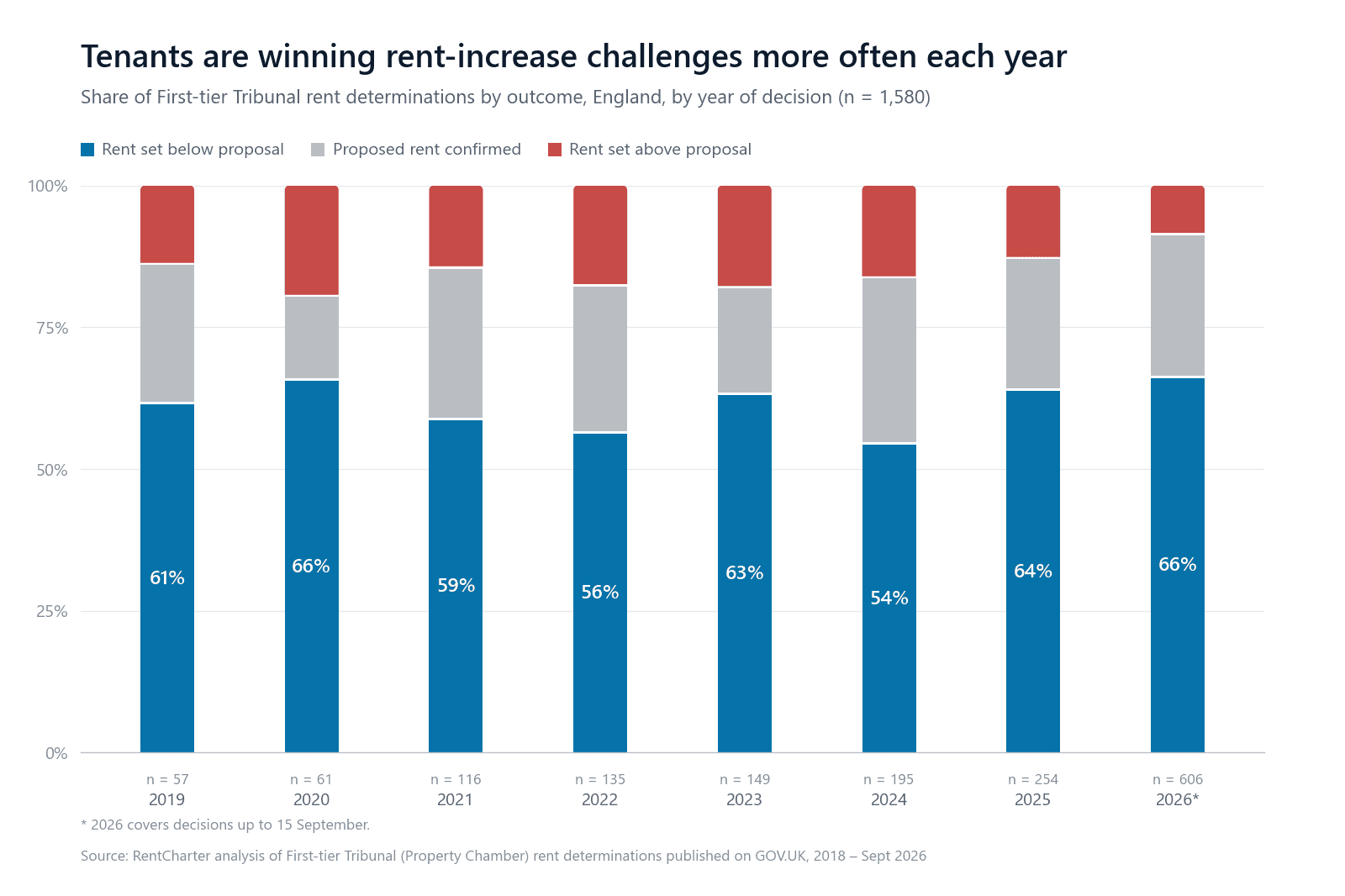
Challenging costs little. £47 application fee — waived if your notice is dated before 1 May 2026 or you rent from a social landlord, and Help with Fees can reduce it to £0 if you have little or no savings. Most cases are decided on the papers, the rent is not backdated while you wait, and across all 1,580 published decisions with a measurable outcome the tribunal set the rent below the landlord's figure in 62.5% of cases — see our analysis of the rent tribunal success rate.
Scotland and Wales are different
Much of the “rent cap” news coverage in the UK is about Scotland, which has gone a different way. Scotland ran an emergency rent cap from 2022 to 2024 and has since legislated, in the Housing (Scotland) Act 2025, for ministers to be able to designate rent control areas. None of that applies in England. Scottish tenants should start with Shelter Scotland.
Wales has no rent cap either. Under the Renting Homes (Wales) Act 2016 rent can rise once a year with two months' notice, but the notice, the tribunal and the challenge process are all different from England's — Shelter Cymru covers it. Northern Ireland has its own system again. Everything else on this page is England only.
What to do with an above-market increase
- Check the notice is valid. Prescribed form, two months' notice, at least a year since the last increase. The Section 13 checker runs the tests.
- Check the figure against the market. Run the rent check. If the proposed rent is above the upper quartile for comparable local lets, you have a case.
- Write back. Use one of the rent increase letter templates to ask for the notice to be withdrawn or the figure reduced.
- Apply before the start date if needed. Your application must reach the tribunal before the date the new rent in the Section 13 notice would take effect. Our walkthrough of applying to the First-tier Tribunal covers the form and the evidence.
FAQ
Did the Renters' Rights Act 2025 introduce rent controls?
No. The Act kept market-rate rents and rejected a statutory cap or a maximum percentage. What it added were procedural limits (once a year, two months' notice, Section 13 only) and a ceiling enforced by the First-tier Tribunal: the rent cannot be pushed above what similar properties let for locally.
Is there a maximum rent increase percentage in England?
No. There is no percentage rule. A 20% increase can be lawful if the rent was well below market, and a 5% increase can be challengeable if the rent was already at market. The test is the local open market rent for a similar property, not the size of the jump.
Is there a cap on how much rent Universal Credit or housing benefit will pay?
Yes, but it caps the benefit, not the rent. Local Housing Allowance rates set the maximum housing element a private renter can receive, by area and by the number of bedrooms you are assessed as needing. Your landlord can still charge more than the LHA rate; you cover the gap.
Can my landlord increase rent more than once a year?
No. Section 13 can be used once in any 12-month period, and clauses in the tenancy agreement that set automatic or scheduled increases have no effect. A second notice within the year is premature and does not take effect.
Is there a rent cap in London?
No. Rent-setting law is national. London has exactly the same rules as the rest of England: no cap, Section 13 once a year, and a tribunal that can hold the rent at the local market level. The Mayor of London has called for rent control powers but does not have them.