What Form 4A is
Form 4A is the Section 13 rent increase notice for private tenants in England. Since 1 May 2026 it is the only way a private landlord can impose a new rent: not a letter, not an email, not a clause in your contract, not a “renewal” at a higher figure. If the document you have been handed is headed “Form 4A” or “Landlord's notice proposing a new rent for assured tenancies in the private rented sector”, it is the real thing, and a deadline is now running.
The form is published by the Ministry of Housing, Communities and Local Government on the gov.uk assured tenancy forms page. Landlords fill it in; tenants do not. What matters to you is what the boxes say and whether the notice meets the legal requirements.
What each part of the form means
Layouts can change between versions, but every Form 4A carries the same information. Reading it in this order tells you what you need to know:
- Your name and the property address. These must be right. A notice addressed to the wrong tenant, or to the wrong flat, is one of the ways a notice fails.
- The current rent. Check it against what you actually pay. If the landlord has quoted a figure that includes something you pay separately, or the wrong amount, note it.
- The proposed new rent. This is the number the whole notice exists to deliver. It should be a rent for the property, not a bundle: if council tax, water or other charges are included in the rent, the form asks the landlord to show them separately, because the tribunal only sets the rent.
- The date the new rent starts. The most important box on the page. It must be at least two months after the notice was served on you, at least 52 weeks after the last increase took effect (or the tenancy began), and the first day of a rent period. Write this date down: your tribunal application must arrive before it.
- Landlord or agent details and signature. Who served it and when. If an agent signed, that is fine; it still counts as the landlord's notice.
- The notes to the tenant. The form tells you, in the government's words, that you may apply to the First-tier Tribunal before the start date if you think the proposed rent is above the market, and that if you do nothing the new rent takes effect. Those notes are a summary of your rights, not a condition of them.
Is the Form 4A you received valid?
A notice that fails the legal requirements does not increase your rent at all. Seven things to check:
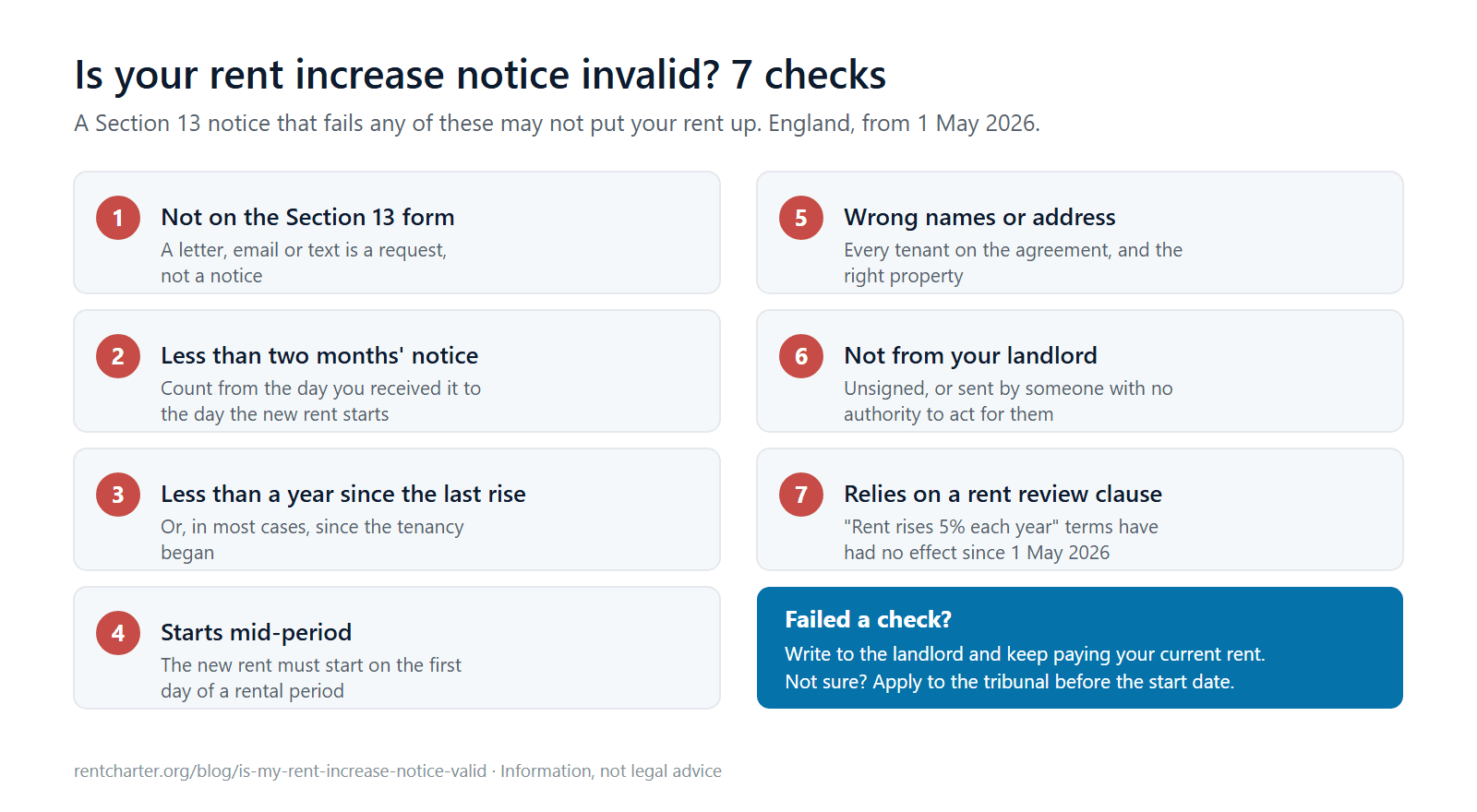
- Is it on Form 4A, or does it contain all the same information?
- Was it served at least two months before the start date?
- Has it been at least 52 weeks since the last increase took effect?
- Is the start date the first day of one of your rent periods?
- Are your name and the property address correct?
- Is the proposed figure a rent, with any other charges itemised?
- Was it actually served on you, in a way your tenancy allows?
The Section 13 checker runs these for you, and is my rent increase notice valid explains each one. If the notice looks invalid, get advice before you rely on that, and keep the start date as your deadline until an adviser confirms it: a tenant who treats a valid notice as invalid ends up paying the new rent with no way to challenge it.
Your three options
- Accept. Do nothing and pay the new rent from the start date.
- Negotiate. Offer a lower figure in writing, backed by comparables. The rent increase letter templates include a counter-offer. You can negotiate and apply to the tribunal at the same time; if you settle, you withdraw.
- Apply to the tribunal. Form MR1 or the online service. Your application must reach the tribunal before the date the new rent in the Section 13 notice would take effect. £47 application fee — waived if your notice is dated before 1 May 2026 or you rent from a social landlord, and Help with Fees can reduce it to £0 if you have little or no savings. Under the Renters' Rights Act 2025 the tribunal can only confirm or lower the proposed rent — never raise it.
Before choosing, find out where the proposed figure sits against similar lets nearby with the free rent check. That number decides which option makes sense.
Form 4 vs Form 4A
Until 30 April 2026, Section 13 notices for all assured tenancies in England used Form 4. From 1 May 2026, when the Renters' Rights Act 2025 took effect, private rented tenancies moved to Form 4A and Form 4 was kept for social housing only. The differences that matter to a private tenant:
- Notice period: two months on Form 4A, against one month under the old rules.
- Tribunal outcome: for a Form 4A notice the tribunal can only confirm or lower the proposed rent. Under the old rules it could set a higher figure, which deterred challenges.
- When the new rent starts after a challenge: from the tribunal's decision, not backdated to the notice date.
- Fee: £47 for Form 4A notices; notices dated before 1 May 2026 were free to challenge.
If you hold a notice dated before 1 May 2026, the old rules apply to it. For anything served since, Form 4A and the rules above.
FAQ
What is Form 4A?
Form 4A is the prescribed Section 13 notice for private rented tenancies in England from 1 May 2026. Its full title is 'Landlord's notice proposing a new rent for assured tenancies in the private rented sector'. It is the only way a private landlord can impose a rent increase: the form states the current rent, the proposed rent and the date the new rent would start, and tells you that you can apply to the First-tier Tribunal before that date.
Is Form 4 still valid?
Not for private tenancies. Form 4 was the pre-May 2026 version and is now used only for social housing. A private landlord serving a notice on or after 1 May 2026 should use Form 4A. A notice that is not on the prescribed form can still be valid if it contains all the same information, so do not assume an old form or a home-made letter is void; check its contents and get advice.
Where can I download Form 4A?
From the 'Assured tenancy forms' page on gov.uk, which lists Form 4A as a PDF under the private rented sector forms. You do not need to fill anything in: the form is for the landlord to complete and serve on you.
Do I have to sign or return Form 4A?
No. Form 4A is a notice, not an agreement. Signing or returning it is not required and does not change your rights. If you do nothing, the new rent takes effect on the date stated; if you apply to the tribunal before that date, the tribunal decides the rent.
Can Form 4A be sent by email?
It can be served by email only if your tenancy agreement allows notices to be served that way, or you have agreed to it. Otherwise the landlord should serve it by post or by hand. If you received it by email and your agreement says nothing about email, mention that to an adviser, but keep treating the start date as your tribunal deadline until the point is settled.
What form do I use to challenge Form 4A?
Form MR1, 'Apply for an open market rent determination', or the equivalent online service on gov.uk. The application must reach the tribunal before the start date on Form 4A. The fee is £47, reduced to nothing through Help with Fees if you have little or no savings and a low income.