Is my rent increase too high? The short answer
It depends on the market, not the percentage. There is no rent cap in England and no maximum increase. A rent increase is too high when it takes your rent above what similar homes let for in your area. That is the line the First-tier Tribunal holds if you challenge it.
The percentage is still a useful early warning. The bigger the rise, the more likely it overshoots the market, and the published decisions show that clearly: the tribunal cut 50% of proposed rises under 10%, and 89% of rises of 50% or more.
Rent increases of each size, compared
We grouped 1,266 published tribunal decisions in England by the size of the rise the landlord proposed, and counted how often the tribunal set a lower rent.

- Under 10%: cut in 50% of cases. Small rises are more often in line with the market, but half were still reduced.
- 10% to 20%: cut in 64% of cases. This is where most notices land.
- 20% to 30%: cut in 68% of cases.
- 30% to 50%: cut in 80% of cases.
- 50% or more: cut in 89% of cases. Increases this large are very often above the market.
Turning a percentage into pounds
Landlords tend to quote the new rent; tenants tend to think in percentages. To compare them:
- Percentage rise = (new rent − current rent) ÷ current rent × 100. £1,200 to £1,380 is £180 ÷ £1,200 = 15%.
- Yearly cost = monthly increase × 12. That 15% rise costs £2,160 a year.
The rent increase calculator does both, and the yearly figure is worth keeping in mind when you weigh up the £47 cost of challenging it. See is a rent tribunal worth it.
The real test: what similar homes let for
When a tenant refers a Section 13 notice, the tribunal asks one question: what would this property let for on the open market, today, to a new tenant? It looks at comparable lets nearby, then adjusts for your home's condition, size and what the landlord provides. Improvements you paid for yourself are ignored. Our guide to open market rent explains how panels reach the figure.
That gives you a practical rule of thumb:
- New rent above the local upper quartile: likely too high. You have a strong case.
- Between the median and the upper quartile: arguable, especially if your home is in worse condition than the comparables.
- At or below the median: probably in line with the market, even if the percentage looks steep.
What landlords ask for vs what tribunals set
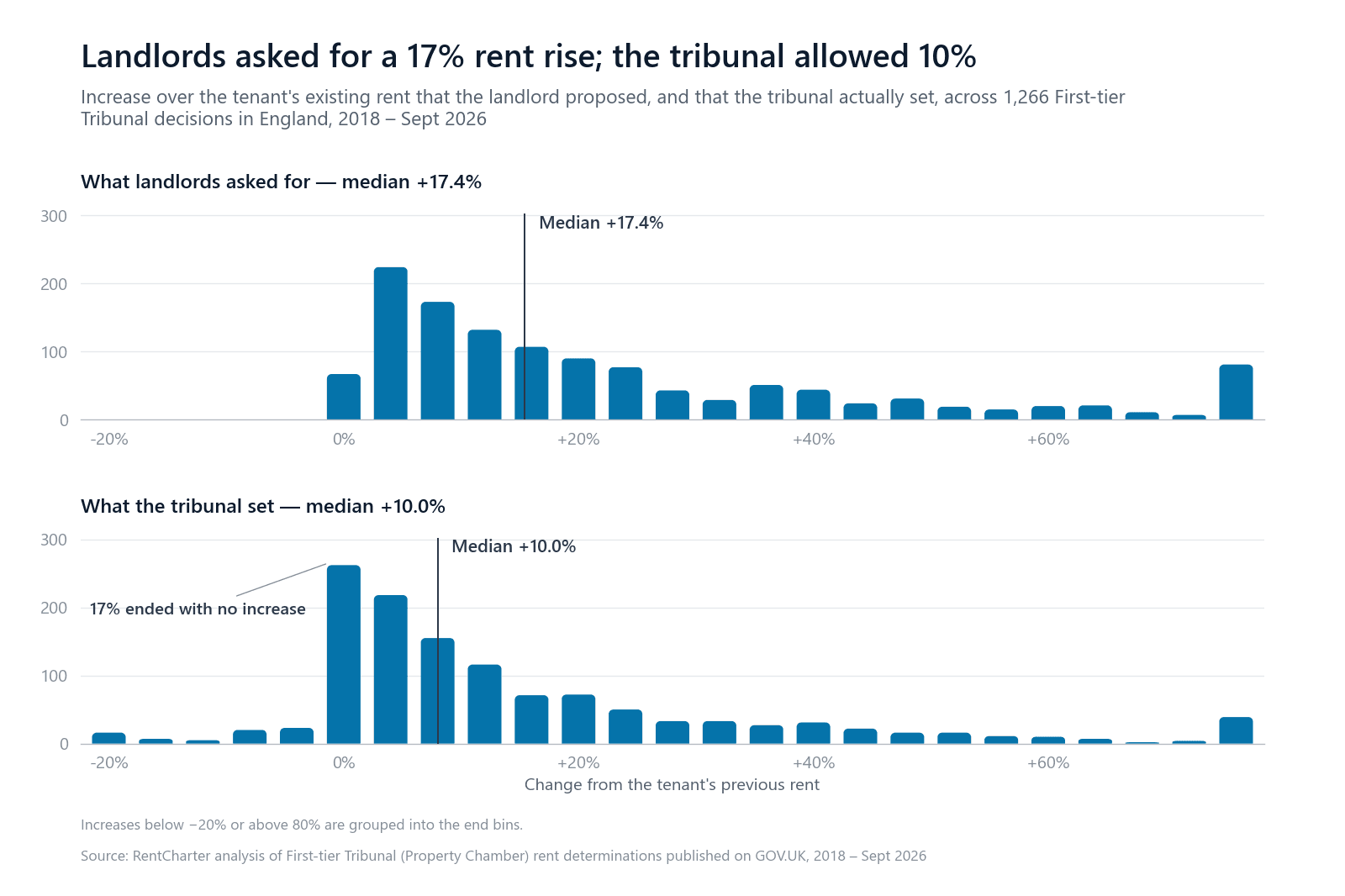
Across the same decisions, landlords proposed a median rise of 17.4%. The tribunal set a median rise of 10%, and 17% of tenants came away with no increase at all.
If your rent increase looks too high
- Check the notice is valid. Run through the seven Section 13 checks. An invalid notice doesn't raise your rent at all.
- Compare it with the market. Use the rent check for your postcode, and the tribunal decisions database for rents the tribunal has actually set nearby.
- Make a counter-offer. Propose a figure in line with the comparables, using the counter-offer guide.
- Apply to the tribunal before the start date if your landlord won't move. The tribunal can only confirm or lower the figure.
FAQ
Is a 10% rent increase legal?
It can be. England has no maximum percentage, so a 10% rise is lawful if it comes by a valid Section 13 notice. Whether it sticks depends on the market: if 10% takes your rent above what similar homes let for locally, the tribunal can lower it. In published decisions, rises of 10–20% were cut in 64% of cases.
Is a 20% rent increase too much?
Often, but not always. A 20% rise on a rent that was well below market can be justified; the same rise on a rent already at market usually is not. Rises of 20–30% were cut by the tribunal in 68% of published decisions.
Can a landlord increase rent by 50%?
They can propose it by Section 13 notice, but it rarely survives a challenge. Where landlords proposed 50% or more, the tribunal set a lower rent in 89% of published decisions.
Is rent tied to inflation (CPI)?
No. There is no link between rent increases and CPI or RPI in England, in either direction. The tribunal's test is the open market rent for your home, so a rise below inflation can still be too high and one above inflation can still be fair.
What is a normal rent increase in 2026?
It varies by area and by how far your rent has drifted from the market. In published tribunal cases landlords proposed a median rise of 17.4% and the tribunal set a median of 10%. The only reliable check is to compare your proposed rent with similar lets in your postcode.