Rent increase vs inflation: the short answer
Inflation is not the test. In England a landlord can raise a private rent to the open market rent for the property, once a year, by Section 13 notice. Whether that is above or below CPI is legally irrelevant. An increase “in line with inflation” can be too high; an increase well above inflation can be fair. What decides it is what similar homes nearby let for now.
That cuts both ways, and landlords use the inflation framing in both directions: “it's only inflation” to make a rise sound automatic, and “rents have gone up more than inflation” to justify a bigger one. Neither statement answers the only question the tribunal asks.
Inflation vs rent growth right now
The two numbers people compare are the Consumer Prices Index and the ONS Price Index of Private Rents. For the latest periods published:
- CPI inflation: 3.1% (12 months to August 2026).
- Private rents, England: up 4% (12 months to August 2026), to an average of £1,459 a month.
On a £1,200 rent, CPI would add about £37 a month and the England rent-growth figure about £48. Both are national averages. Rent growth in the year to August 2026 ran from 3.0% in the South East to 5.8% in the North East and North West, and within a city it varies street by street. Source: ONS, Private rent and house prices, UK (September 2026 bulletin) and Consumer price inflation (August 2026).
The legal test is market rent, not CPI
When a tenant refers a Section 13 notice to the First-tier Tribunal, section 14 of the Housing Act 1988 tells the tribunal to decide the rent at which the property “might reasonably be expected to be let in the open market by a willing landlord”. Inflation does not appear in the section. Panels look at comparable lettings: asking rents and, with more weight, rents actually achieved for similar properties nearby, adjusted for condition and features.
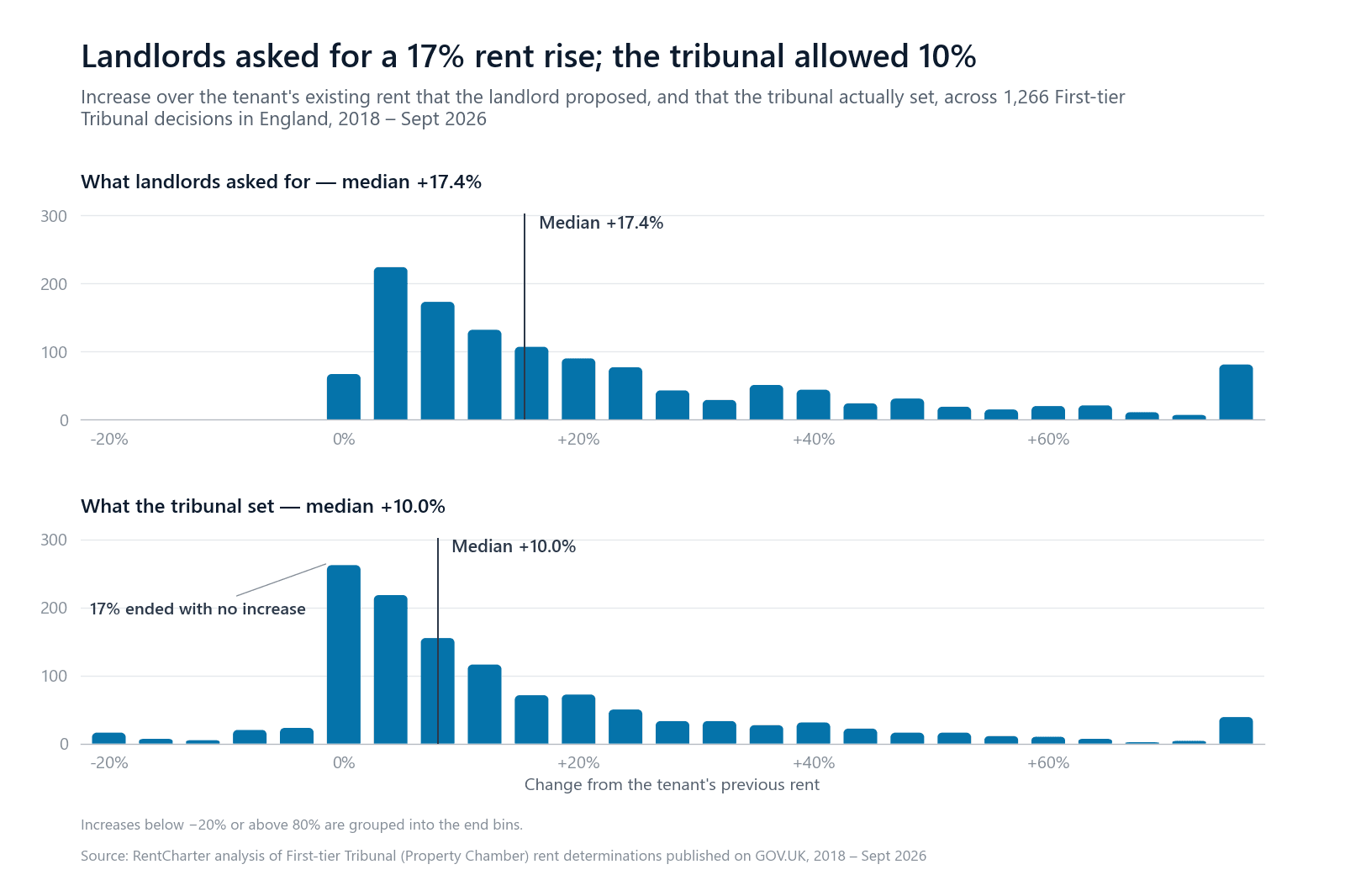
The published decisions show how far the inflation framing is from what happens in disputes. Across 1,266 decisions where both figures are stated, landlords asked for a median rise of 17.4%, several times the inflation rate; the tribunal set a median of 10%, and 17% of tenants ended with no increase at all.
Inflation clauses in your contract
Many agreements signed before 2026 contain a rent review clause: “the rent will increase annually by RPI” or “by CPI plus 1%”. Since 1 May 2026 those clauses have no effect in private tenancies in England. The Renters' Rights Act 2025 made the Section 13 notice the only route to a rent increase, so a landlord who wants the inflation uplift has to serve the notice, give two months, and accept that the figure can be referred to the tribunal and tested against the market.
If your landlord simply applies the clause and asks for the new amount, that is an informal request. You can decline it and keep paying your current rent; see can I refuse a rent increase. Do not start paying the uplifted figure “because the contract says so”: paying can be treated as agreeing.
When an above-inflation rise is fair, and when it is not
Fair: your rent has not changed for three years, local rents have risen 15% in that time, and the proposed figure lands at what similar flats now let for. Inflation over the period is beside the point; the market moved and your rent is catching up.
Not fair: your rent was set at market last year, the landlord now asks for “10%, because everything has gone up”, and comparable lets nearby are flat. The tribunal would set the rent at the comparables, which may be your current rent.
The size of the ask is itself a signal. In published decisions, proposed rises under 10% were cut 50% of the time and rises of 10–20% 64% of the time; the larger the increase, the more often the tribunal found it above market. See is my rent increase too high for the full table.
What to do
- Ignore the index, find the comparables. The free rent check compares the proposed figure with similar lets in your postcode area; the comparables guide shows how to build your own list.
- Check the notice. An inflation uplift that arrived by email, or under a review clause, is not a Section 13 notice. Run the Section 13 checker.
- Counter-offer with evidence. “Comparable two-beds on [street] let for £X” beats “that's more than inflation” every time. Templates in rent increase letter to landlord.
- Keep the deadline. Your application must reach the tribunal before the date the new rent in the Section 13 notice would take effect. Under the Renters' Rights Act 2025 the tribunal can only confirm or lower the proposed rent — never raise it.
FAQ
Can a landlord increase rent above inflation?
Yes. There is no rule in England that ties private rent increases to CPI, RPI or any other index. The only legal limit is the open market rent for the property: if similar homes nearby now let for 8% more, an 8% increase can be fair even when inflation is 3%. Equally, an increase 'in line with inflation' is not automatically fair if local rents have not moved.
Is a rent increase linked to RPI or CPI in my contract still valid?
Not since 1 May 2026. Rent review clauses in private tenancies in England, including ones that raise rent by an inflation index each year, no longer have any effect. The only way a landlord can increase the rent is a Section 13 notice, once in any 52 weeks, with at least two months' notice.
Does rent go up with inflation automatically?
No. Nothing happens to your rent unless your landlord serves a valid Section 13 notice and you accept it or the tribunal confirms it. If you receive an email saying your rent is 'being adjusted for inflation', that is a request, not a notice, and you can decline it.
What is a reasonable rent increase in 2026?
There is no official figure. For context, CPI inflation was 3.1% (12 months to August 2026) and average private rents in England rose 4% (12 months to August 2026) according to the ONS. Those are national averages: the only number that matters for your rent is what comparable homes in your postcode area let for now.
How do I calculate a rent increase in line with inflation?
Multiply your current rent by the inflation rate and add it on: £1,200 × 3.1% = about £37 a month more. The rent increase calculator has an inflation mode that does this for any rate, and then shows where the result sits against local market rents, which is the test that actually applies.