Can I refuse a rent increase? The short answer
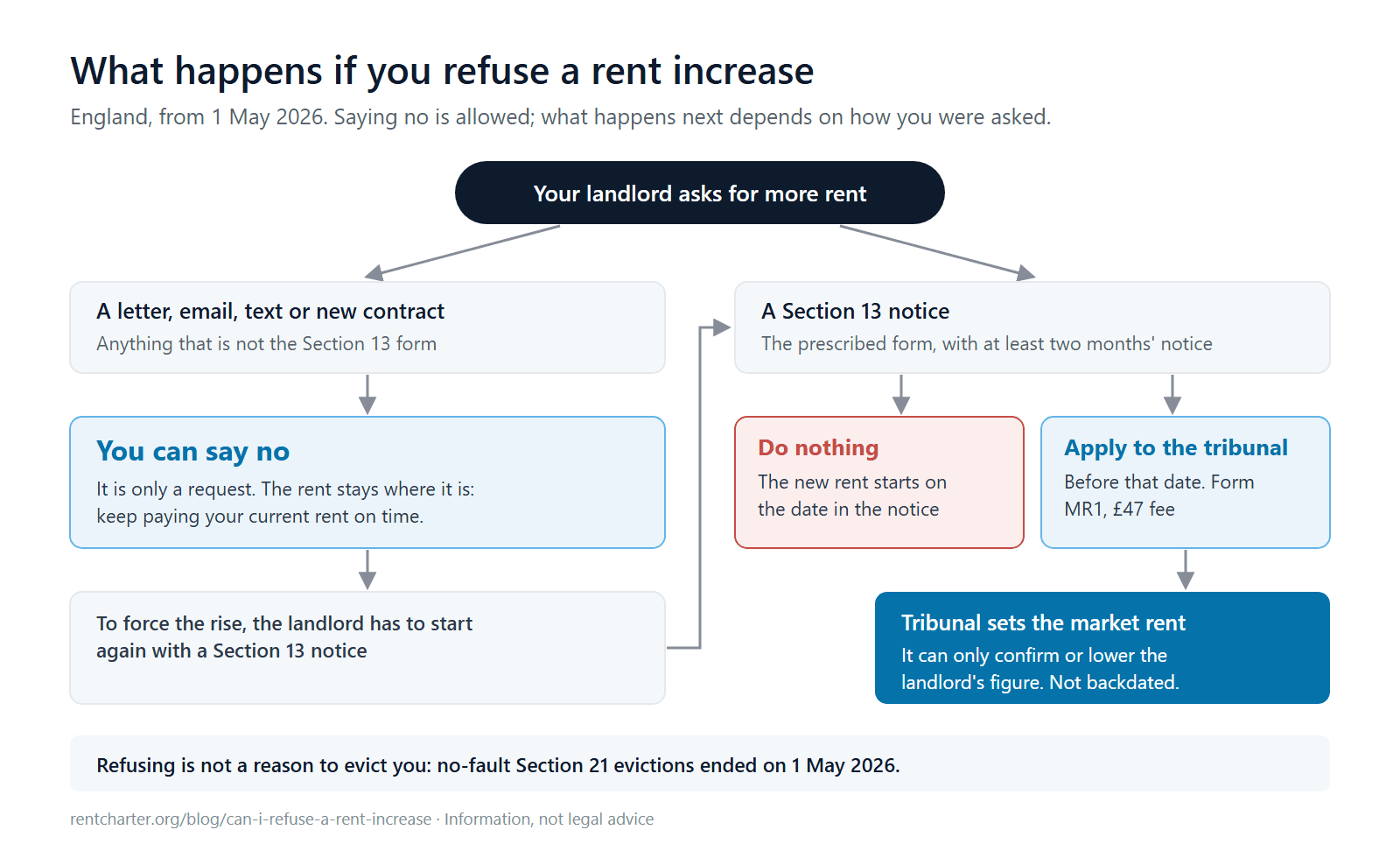
Yes, in most cases. In England a landlord can only force a rent increase on a private tenant one way: a Section 13 notice on the prescribed form, with at least two months' notice. Any other request for more rent, whether a letter, an email, a text or a new contract to sign, is just a request, and you can say no.
A valid Section 13 notice is different. Refusing it in your head does nothing: if you take no action, the new rent starts on the date in the notice. To refuse it properly you apply to the First-tier Tribunal before that date, and the tribunal decides the rent. Since 1 May 2026 it can only confirm your landlord's figure or lower it.
Refusing an informal rent increase request
Landlords and agents often skip the formal route and simply write: “your rent will be £1,350 from next month”. However firm it sounds, that is not a notice. It has no legal effect on your rent unless you agree to it. The same applies to:
- an email or text announcing a new rent;
- a “renewal” contract at a higher rent (tenancies in England no longer have fixed terms to renew; see what is a rolling tenancy);
- a rent review clause in your agreement, such as “rent rises by 5% each year”. These have had no effect since 1 May 2026.
You can decline in writing and carry on paying your current rent on time. Be careful not to start paying the new amount “to keep the peace”. Paying it can be treated as agreeing to it.
Refusing a Section 13 notice
If what you received is on the Section 13 form, check first that it is actually valid. A notice that gives less than two months, comes less than a year after your last increase, or starts the new rent mid-period may not take effect at all. Our seven checks for a Section 13 notice go through each one, and the Section 13 checker runs them for you.
If the notice is valid, you have three choices:
- Accept it. Do nothing, and the new rent is due from the start date.
- Negotiate. Offer a lower figure in writing. Many landlords would rather settle than go to the tribunal. The rent increase letter templates include a counter-offer.
- Refer it to the tribunal. Your application must reach the tribunal before the date the new rent in the Section 13 notice would take effect. £47 application fee — waived if your notice is dated before 1 May 2026 or you rent from a social landlord, and Help with Fees can reduce it to £0 if you have little or no savings.
Negotiating and applying are not either/or. You can apply to protect your position and keep talking; if you reach a deal, you can withdraw. What you cannot do is wait past the start date and then apply.
Can my landlord evict me for refusing?
This is the fear that stops most people saying no, and the rules changed a lot in 2026. No-fault Section 21 evictions ended on 1 May 2026. To end a tenancy now, a landlord in England needs one of the legal grounds in Section 8, and in most cases a court order. Refusing an informal increase, or referring a Section 13 notice to the tribunal, is not one of those grounds.
Two things still matter:
- Keep paying the rent that is legally due. Rent arrears are a ground for possession. Refusing an increase never means withholding rent.
- Selling or moving in are still grounds. A landlord who genuinely wants to sell or move back in can use those grounds, with four months' notice, and not in the first year of a tenancy. They carry restrictions on re-letting the property afterwards, which makes them a poor tool for punishing a tenant.
What to say to your landlord
Keep it short, polite and in writing. For an informal request:
Thank you for your message about the rent. I don't agree to the increase, and I will carry on paying my current rent of £[X] on the usual date. If you would like to propose a change, I would ask that it is made by a Section 13 notice so that I can consider it properly.
For a Section 13 notice you think is above the market:
I have received your notice proposing a rent of £[Y] from [date]. Comparable properties nearby let for around £[Z], so I don't think the proposed figure reflects the market. I'd be happy to agree £[Z]. Otherwise I will refer the notice to the First-tier Tribunal before the start date.
The “£[Z]” is what makes that second letter work. Pull your comparables from the rent check or the guide to finding rent comparables. The three full templates are in how to respond to a rent increase letter.
What usually happens when tenants push back
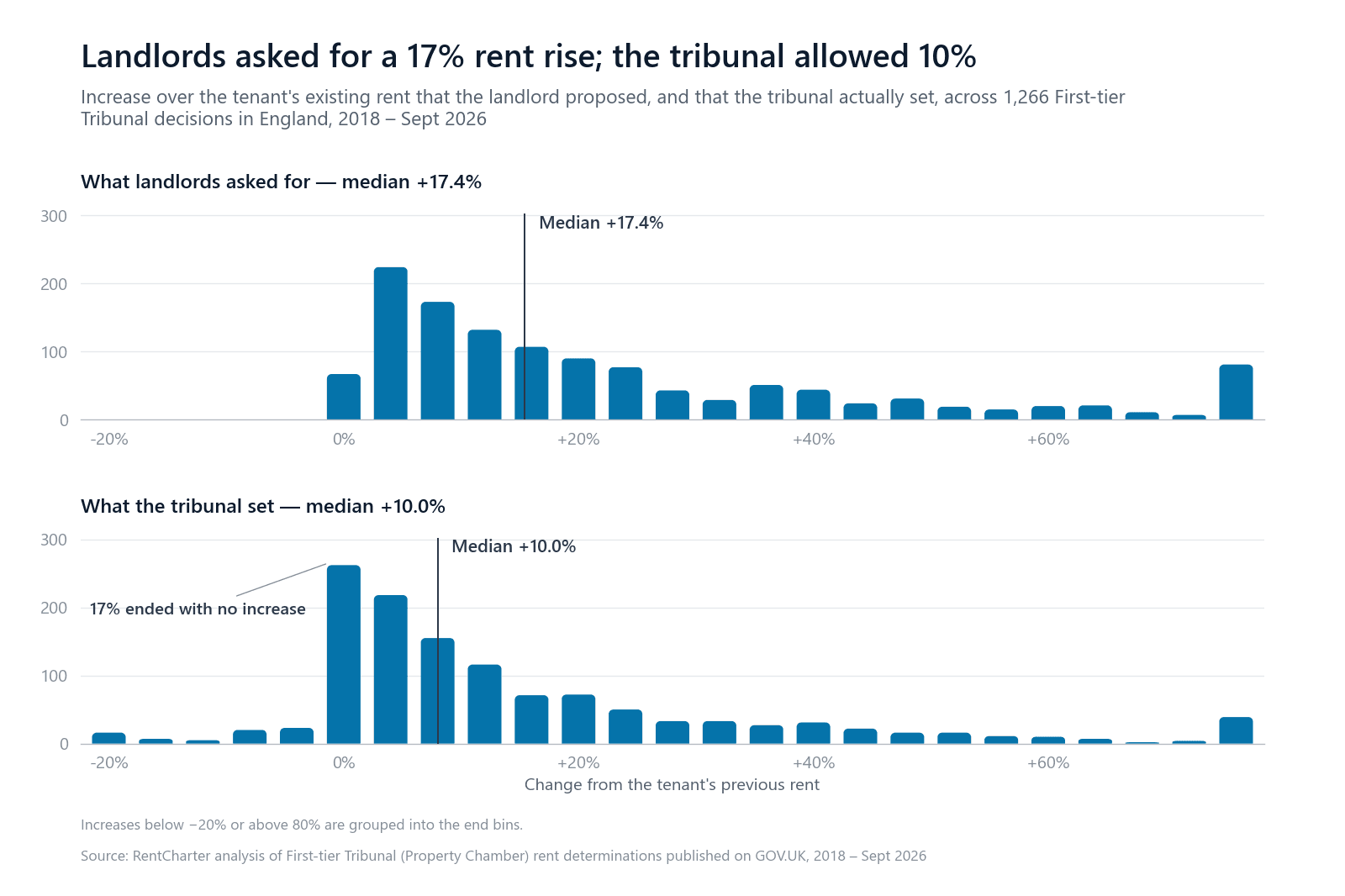
The published tribunal decisions show what saying no tends to be worth. Across 1,266 decisions, landlords proposed a median rise of 17.4%. The tribunal set a median of 10%, and 17% of those tenants ended up with no increase at all.
Most disputes never get that far. A landlord who can see you know the process, and have the local figures, has a strong reason to settle, because a tribunal takes months and the new rent is not backdated while it decides. For the full numbers, see the rent tribunal success rate and whether a rent tribunal is worth it.
FAQ
Can I just refuse to pay a rent increase?
You can refuse an increase that has only been requested (by letter, email, text or a new contract) and keep paying your current rent. You cannot simply refuse a valid Section 13 notice: if you do nothing, the new rent becomes payable on the date in the notice. The way to refuse a valid notice is to apply to the First-tier Tribunal before that date.
Can my landlord evict me for refusing a rent increase?
Not for refusing as such. No-fault Section 21 evictions ended on 1 May 2026, so a landlord in England needs a legal ground under Section 8. Refusing an informal request, or challenging a Section 13 notice at the tribunal, is not a ground. Falling into rent arrears is, so always keep paying the rent that is legally due.
What if my landlord asks me to sign a new tenancy agreement at a higher rent?
You do not have to sign it. Since 1 May 2026 every private tenancy in England rolls on with no end date, so there is nothing to renew. A new agreement is just another way of asking for more rent; if you decline, your existing tenancy and rent carry on.
Does paying the higher rent mean I have agreed to it?
It can be treated that way. If you start paying a higher figure that was only requested informally, your landlord may argue you agreed to a new rent. If you want to keep your options open, pay your existing rent and put any disagreement in writing.
How long do I have to refuse a Section 13 rent increase?
Until the day before the new rent is due to start. Your tribunal application must reach the tribunal before the start date in the notice, which will be at least two months after you received it. Apply as early as you can.